In a recent post, I put a question from Sami Frashëri beside a modern musical reference to Unikkatil. My short caption named them both. The historical question was whether Albanians were capable of sustaining and protecting themselves.
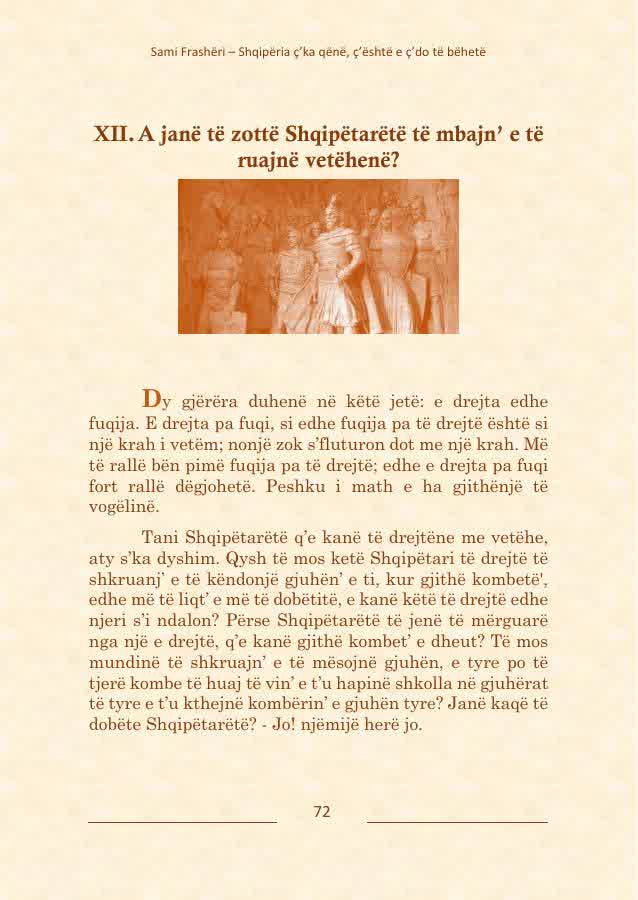
It appears as a section heading in Shqipëria ç’ka qenë, ç’është e ç’do të bëhetë. The digitised edition records the book’s first publication in Bucharest in 1899. Page 72 contains the passage used in my graphic.
Read the argument after the question
Frashëri begins the section by linking rights with the ability to defend them. He then discusses Albanians’ right to read, write and learn their own language. The heading belongs to that argument about national self-determination; it is more specific than a general motivational slogan.
The juxtaposition in my post brings an older question into a contemporary cultural setting. It does not make the modern lines part of Frashëri’s book. They are separate references.
The text is also a historical political argument. Verifying that Frashëri wrote something does not establish every assertion in the book as a present-day historical fact. Here, the source verifies the question and the context immediately around it.
The image shows the relevant page of the digitised edition, not an original 1899 page. The modern song lyrics are not reproduced.
Related article: Why I am reading Sami Frashëri: language, faith and Albanian identity.
Original social post · 2026-10-21
The passage about binding our own hands
On October 26, I shared another page from the book with chain and broken-chain symbols. The highlighted sentence turns Frashëri’s criticism inward: in his account, ignorance also binds people’s own hands. The surrounding passage uses the image of a powerful creature restrained by weaker enemies.
Read beside the earlier question about self-reliance, this passage adds a demand for awareness. The image I shared is a historical author’s political metaphor, not a literal description of present-day peoples. It brings the question back to what people understand and what they can do for themselves.
Source posts: 1