A line about Skanderbeg and Pyrrhus caught my attention: how did a leader describe his own roots when someone challenged his people’s dignity?
Going back to the printed source
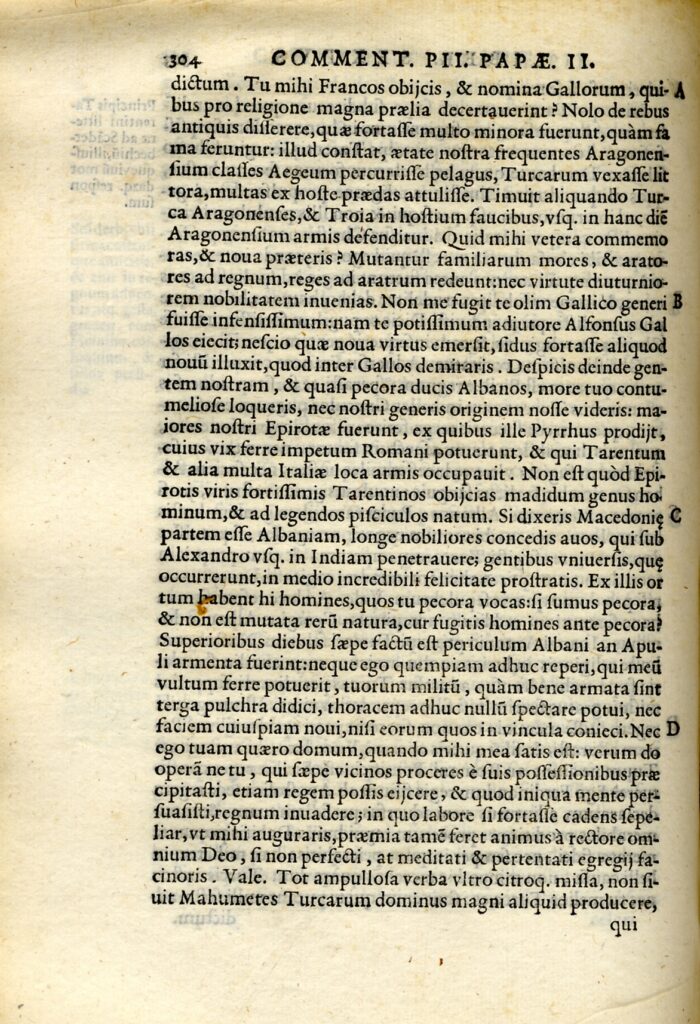
In Book VI of Pius II’s Commentaries, the account of an exchange with Giovanni Antonio, prince of Taranto, includes a reply attributed to George, lord of Albania. The 1584 edition prints the exchange on pages 303–304.
On page 304, the reply reads: “maiores nostri Epirotae fuerunt, ex quibus ille Pyrrhus prodiit” — “Our ancestors were Epirotes, from whom that Pyrrhus arose.” This is a translation of the Latin printed there. Read the scanned page, hosted by the University of Mannheim.
A reply with a purpose
The preceding page records the prince’s hostile remarks about Albanians. The answer invokes Pyrrhus and his campaigns in Italy to push back against that contempt. Earlier in the reply, George also explains his support for Ferdinand through the help he had received from Ferdinand’s father, Alfonso. The exchange begins on page 303.
The important distinction is between a statement preserved in a historical narrative and independent proof of ancestry. Pius records the reply; this printed passage is not an autograph letter by Skanderbeg, nor can it establish a biological line across the intervening centuries.
For me, its value lies in the way history becomes part of a defence of dignity. We can take that connection seriously while remaining precise about what the source actually establishes.
Source checked on 15 October 2026: Pius II, Commentarii, Rome, 1584, Book VI, pp. 303–304. Image: the public-domain printed page, digitised by the University of Mannheim.
Original social post · 2026-10-11