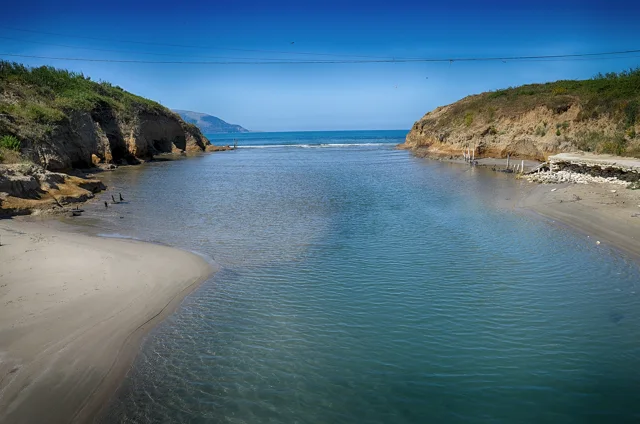
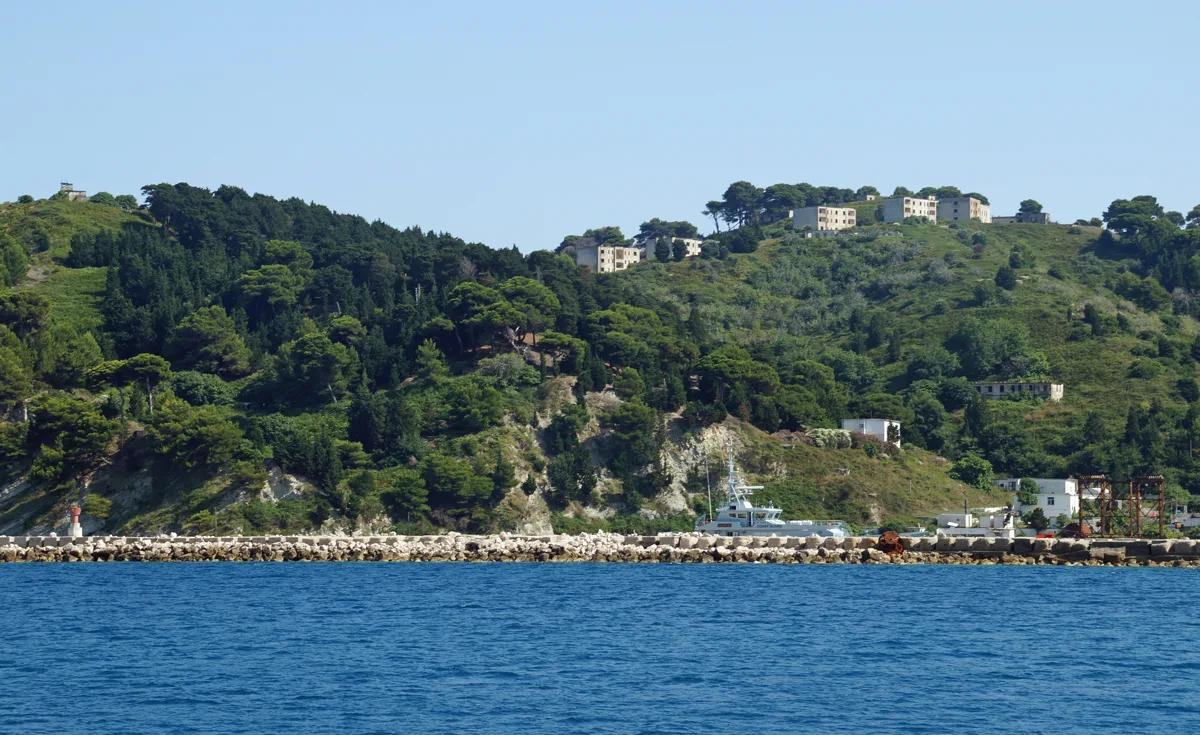
Sazan Island, viewed from Karaburun, July 2016. Historical context; not a photograph of the yacht meeting. Pasztilla / Attila Terbócs · CC BY-SA 4.0 · resized.
Read the labels: Verified record means the cited document supports the stated fact—not that everyone mentioned committed wrongdoing. Reporting, official accounts, allegations and unresolved leads are distinct. This chronology does not establish a common cause for every controversy.
How to read a connection
Person or placeSpecific claimPerson or organisation
A line represents the claim written on it. Open its sources and limitations before drawing a conclusion.
Verified recordThe cited document supports the stated fact.
Reported / official accountAttributed reporting or an institution’s account; check the underlying evidence.
Allegation / unresolvedA claim or open question, not an established finding.
THE STORY, AT A GLANCE
Six chapters. Follow the evidence.
Open a chapter for its context, evidence and source. Then continue into the full story.
01 · 2021A meeting on the waterExplore chapter +
Reported
Kushner’s family trip brought him to Albania. In Rama’s later account, an invitation aboard a yacht in Durrës introduced the two men. Reporting dates the encounter to summer 2021.
This is a retrospective account. The host’s identity is not consistently established; the meeting does not prove a financing arrangement.
04 · 30 December 2024Sazan enters the approval processExplore chapter +
Verified record
AIDA’s information-request register refers to Decision 23 and applicant Atlantic Incubation Partners LLC. Reuters reported strategic-investor status for the Kushner-linked proposal.
Strategic status is not a land deed or a construction permit. The complete signed decision and ownership chain remain outstanding.
05 · March–June 2026Two places. Different decisions.Explore chapter +
Official account
The government’s June account distinguishes Sazan from Zvërnec: Sazan remained state property without a final agreement then. For Zvërnec it cited a 30 March development approval and 15 May environmental decision.
This is the government’s account, not an independent inspection of every permit. Sazan and Zvërnec must not be treated as a single land transaction.
06 · 30 May–October 2026From the coast to the streetsExplore chapter +
Reported
OSW traces the environmental demonstrations to 30 May. By October, reporting describes broader student demands about education, living costs and accountability.
Political support does not prove control of the movement. No reliable central financing account has been established here.
Kushner’s family trip brought him to Albania. In Rama’s later account, an invitation aboard a yacht in Durrës introduced the two men. Reporting dates the encounter to summer 2021.
This is a retrospective account. The host’s identity is not consistently established; the meeting does not prove a financing arrangement.
AIDA’s information-request register refers to Decision 23 and applicant Atlantic Incubation Partners LLC. Reuters reported strategic-investor status for the Kushner-linked proposal.
Strategic status is not a land deed or a construction permit. The complete signed decision and ownership chain remain outstanding.
The government’s June account distinguishes Sazan from Zvërnec: Sazan remained state property without a final agreement then. For Zvërnec it cited a 30 March development approval and 15 May environmental decision.
This is the government’s account, not an independent inspection of every permit. Sazan and Zvërnec must not be treated as a single land transaction.
OSW traces the environmental demonstrations to 30 May. By October, reporting describes broader student demands about education, living costs and accountability.
Political support does not prove control of the movement. No reliable central financing account has been established here.
The story opens into a wider record of contracts, companies, diplomacy and public claims. Explore each thread separately; proximity is not proof of wrongdoing.
Law 21/2024: what changed in Albania’s protected areas?
Parliament amended the 2017 protected-areas law on 22 February 2024. The changes expressly permit five-star tourism and agrotourism activities and their supporting infrastructure, weaken several specific restrictions and expand the National Territorial Council’s role. They do not abolish protected areas or automatically approve a particular resort.
Article numbers below distinguish the 2024 amending law from the provisions it changes in Law 81/2017. English descriptions are editorial translations; the linked Albanian text is authoritative.
Permitted activities · amendment Article 14 → base Article 33
Before · 2017
The 2017 law already allowed controlled activities and tourism infrastructure consistent with management plans, with prior approval and relevant National Territorial Council decisions. It was not a blanket ban on all tourism.
After · 2024
The replacement expressly allows activities in five-star-or-higher “tourism of excellence” accommodation and agrotourism accommodation, plus supporting infrastructure, even if not specified in the protected area’s declaration decision. Monitoring, restoration and environmentally permitted military activities also remain listed.
Core zones · amendment Article 20 → base Article 48
Before · 2017
The original core-zone provisions distinguished levels A and B. Level A expressly prohibited every type of construction.
After · 2024
The replacement uses a single first-degree protection regime and refers to activities allowed by Article 33 and the declaration decision. The blanket construction ban is absent. Specific bans remain, including on hunting, harmful invasive species and listed major infrastructure. “Everything is now permitted” would be inaccurate.
Who can change the rules? · amendment Article 16 → new Article 36/1
Before · 2017
The 2017 framework already involved the Council of Ministers, the environment ministry and the National Territorial Council. The latter did not first acquire a role in 2024.
After · 2024
New Article 36/1 allows changes to technical-formal declaration elements through the Council of Ministers, with territorial-council involvement in zoning. For Article 33(2), (3) and (4) activities, approval of technical development rules by the National Territorial Council itself counts as the amending act. The defined elements include zoning and permitted or prohibited activities, not merely spelling corrections.
Protection principles · amendment Articles 2–3 → base Articles 4 and 9
Before · 2017
The earlier criteria emphasised non-permission of incompatible uses and exclusion or prevention of intensive human use.
After · 2024
The amendments add adaptability and management flexibility, replace “non-permission” with “restriction” in Article 9(c), and require consideration of tourism-related economic activity and supporting infrastructure. Category changes require assessment; this is not automatic declassification after a fire.
Article 1 changes definitions. Articles 4–6 alter declaration procedures and repeal base Article 12(2) and Article 13. Repealing Article 13 does not abolish all zoning: amended Article 47 still provides for internal zones.
Articles 7–12 amend category-specific rules for national parks, natural monuments, managed reserves/nature parks, protected landscapes, marine areas and green belts. They include tourism exceptions and a larger role for territorial-council technical rules. Article 13 shifts specified municipal-park powers from the minister to the mayor.
Article 15 broadens who may propose a change in area boundaries; prior consultation remains in its text. Article 17 creates a framework for national-park administration offices. Article 18 provides tripartite pasture-use contracts involving the park administration, municipality and user.
Articles 19–22 revise internal zoning and core, sustainable-use and recreation subzones. Articles 23–25 address revenue, park-office administration and inspection powers. Article 26 sets six- and eighteen-month implementation deadlines. Article 27 provides entry into force 15 days after Official Gazette publication.
Who proposed it, and who voted for it?
The signed submission identifies 12 Socialist MPs as sponsors: Fadil Nasufi, Florenc Spaho, Arkend Balla, Edona Bilali, Bujar Çela, Anduel Tahiraj, Shpresa Marnoj, Mirela Pitushi, Denis Deliu, Klodiana Spahiu, Enslemvera Zake and Eduard Ndreca. Sponsorship is not an individual voting record.
Contemporary reporting records 74 Socialist MPs voting in favour on 22 February 2024 amid opposition disruption. We have not located an authenticated individual roll call and therefore do not publish a purported list of 74 voters. The 77-vote total reported for the Albania–Italy agreement in the same sitting concerns a different measure.
Committee records identify Fadil Nasufi presenting for the sponsors, Laert Duraj as the responsible committee’s rapporteur, and minister Mirela Kumbaro presenting the government’s position. The European Affairs Committee’s 10 votes in favour, with none against or abstaining, are a committee result, not the plenary tally.
The sponsors’ memorandum and committee reports argue that residents and municipalities needed income, jobs, tourism opportunities and simpler administration. Nasufi cited requests from 15 municipalities. The government proposed substantial revisions and a framework for dedicated park offices. These are recorded justifications, not proof of each MP’s private motive or of benefits actually delivered.
The constitutional challenge argued that the amendments weakened environmental safeguards and had procedural and consultation defects. AOS and EcoAlbania supported that challenge. Separately, the European Commission’s 2025 report assessed the 2024 amendments as a deterioration in nature protection. That assessment is distinct from a court ruling on constitutionality.
The early proposal included at least 20% of a protected area under municipal administration. Do not quote that as the final law: the government and committees substantially rewrote the proposal. The enacted text instead includes municipal-park powers and pasture-contract provisions. Committee records describe consultation in December 2023 and hearings in January–February 2024; the dispute includes whether the substantially changed text received adequate consultation, not simply whether any meetings occurred.
The constitutional case: what the outcome establishes
Decision 45 of 31 July 2025, announced on 31 October 2025, rejected the challenge brought by 37 MPs represented by Ina Zhupa. AOS and EcoAlbania participated in support. The judgment includes dissent and issues on which the required five-judge majority was not reached. Rejection did not repeal the law; it is not certification that every future project is lawful or that the amendments satisfy every EU environmental requirement.
The law changes the legal framework relevant to projects in protected areas. It does not name Jared Kushner, transfer Sazan or Zvërnec, establish ownership, or supply a project’s environmental and construction permissions. For any particular project, the location, protected-area boundaries, declaration decision, permits and land records must be checked separately. A general legal change is not proof that a named person caused it.
Select a map marker or open a place below to explore its story and evidence.
Tirana · Parliament
Institutional context: the cited strategic-investor decision is an executive decision, not a parliamentary vote or proof that it occurred at this marker.
This site uses necessary cookies to work. With your permission, Google Analytics helps me understand which pages people read. Embedded videos may also use third-party cookies. You can accept, reject optional cookies, or choose your preferences, and change your choice at any time.
Functional
Always active
The technical storage or access is strictly necessary for the legitimate purpose of enabling the use of a specific service explicitly requested by the subscriber or user, or for the sole purpose of carrying out the transmission of a communication over an electronic communications network.
Preferences
The technical storage or access is necessary for the legitimate purpose of storing preferences that are not requested by the subscriber or user.
Statistics
The technical storage or access that is used exclusively for statistical purposes.The technical storage or access that is used exclusively for anonymous statistical purposes. Without a subpoena, voluntary compliance on the part of your Internet Service Provider, or additional records from a third party, information stored or retrieved for this purpose alone cannot usually be used to identify you.
Marketing
The technical storage or access is required to create user profiles to send advertising, or to track the user on a website or across several websites for similar marketing purposes.